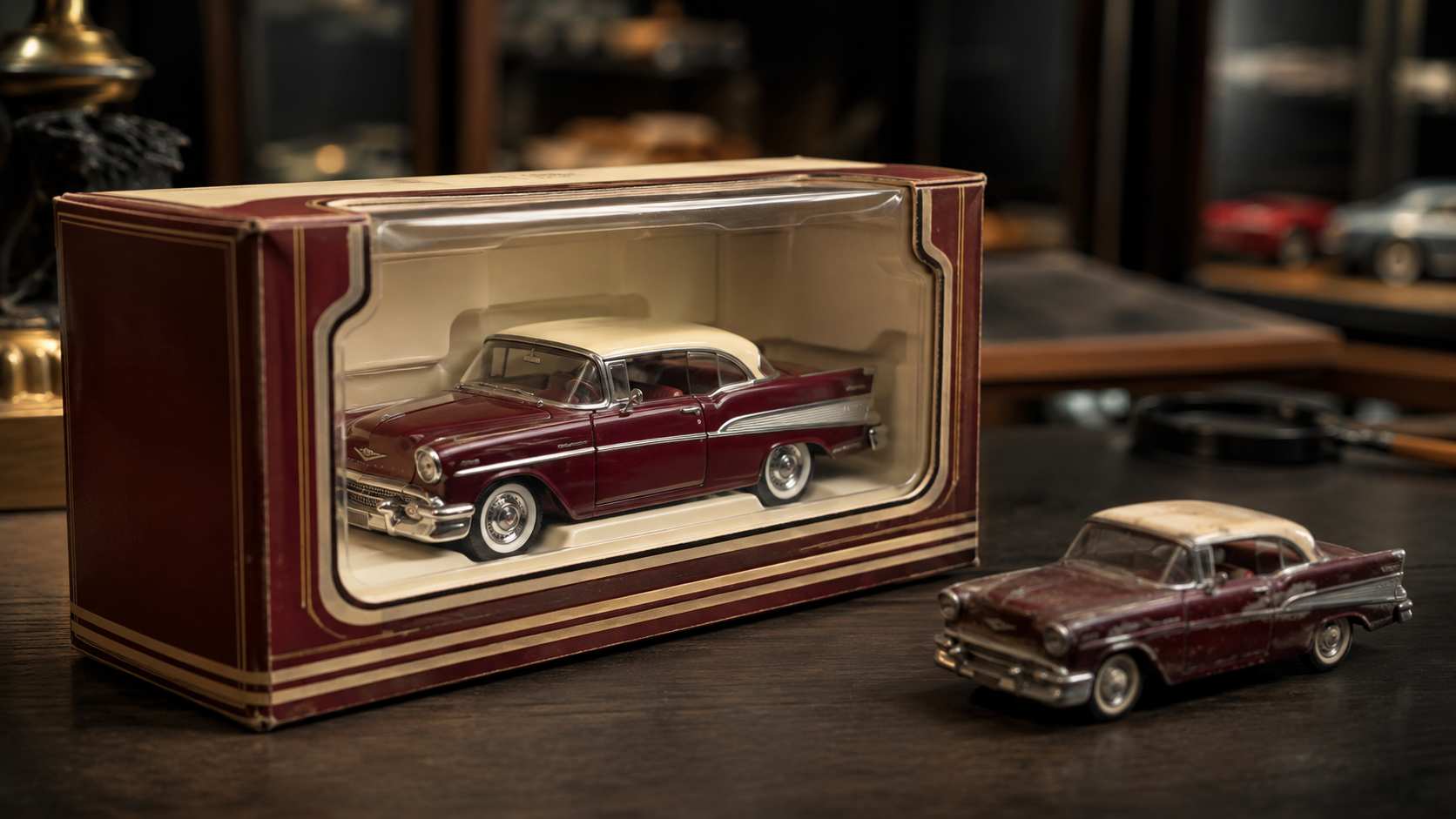
Nowhere in the antiques world does packaging matter as much as it does in toys. A die cast model in mint condition with its original box can be worth several times the same model without one, and in some cases the box is genuinely worth more than the toy inside it. This strikes most people as absurd until they understand what is being priced.
Why is the box worth so much?
Because almost none survived. A toy was bought to be played with, and the box went into the bin the same afternoon in the overwhelming majority of cases. Survival rates for packaging are therefore a small fraction of survival rates for the toys themselves.
Scarcity meeting demand is what creates value, and here the two align perfectly. Collectors want complete examples, complete means boxed, and boxed examples are genuinely rare. The box also confirms exactly which variation a model is, since manufacturers changed colours and details frequently while the catalogue number stayed on the box.
What condition grading applies?
The trade uses a scale running from mint downwards, and it applies separately to the toy and to the box. A description will often state both, so a model might be described as excellent with a good box, meaning the toy is better preserved than its packaging.
Mint means as it left the factory, showing no play wear at all. Excellent allows very minor imperfections. Good indicates obvious play wear, chips to paint and possibly minor missing parts. The steps between grades represent large steps in price, so understanding the terms matters before bidding.
What counts as complete?
More than the toy and the box. Inner packing pieces, card inserts, instruction leaflets, catalogues, spare parts, and any small accessories supplied with the model all form part of a complete example.
These small paper items are frequently the scarcest components of all, because they were discarded even more readily than boxes. A model with its original leaflet and inner packing commands a premium over the same model in a bare box.
Which toys carry the highest values?
Early tinplate, particularly clockwork and lithographed pieces, attracts serious money from specialist collectors. Quality soft toys from established makers, especially early examples with the correct maker identification still attached, do very well.
Die cast vehicles are the largest and most active market, driven by variations in colour, wheel type and box design that can separate a common model from a rare one. Model railways, lead figures and early dolls all have committed followings. In every case the same principle applies: original condition and completeness outrank age.
Should you restore an old toy?
Almost never. Repainting a die cast model destroys most of its value, and the trade can spot a repaint instantly through paint thickness, the wrong shade, and paint where the original process would not have put any.
Original paint with honest chips is worth considerably more than a smooth repaint. The same applies to replacing missing parts with modern reproductions, which must always be disclosed. Cleaning should go no further than removing loose dust with a soft brush.
How should boxed toys be stored?
Card is the vulnerable part. Keep boxes away from damp, direct sunlight and heat, since sunlight fades printed colours quickly and damp causes staining and softening.
Store boxes flat rather than under weight, support the sides so they do not crush, and avoid sticky tape entirely, since adhesive residue damages the printed surface permanently. Lofts and garages are the worst possible locations because of temperature swings and condensation. An interior cupboard is far better.
What should you check before buying?
That the toy and the box actually belong together. Correct box with the wrong model inside is a common problem, whether through innocent mixing over the years or deliberate pairing to lift a price.
Check the catalogue number on the box against the model, look at the colour and details against a reference, and be alert to reproduction boxes, which are made in quantity for the more valuable models. Reproduction card usually feels slightly different, prints slightly too cleanly, and lacks the softening at the corners that decades of handling produce.