Wall clocks cover a wider range than any other clock category, from large public timepieces made to be read across a room to modest domestic examples. What they share is that the case exists to hold a dial rather than to display craftsmanship, which means the movement and the dial carry almost all the information.
What is a dial clock?
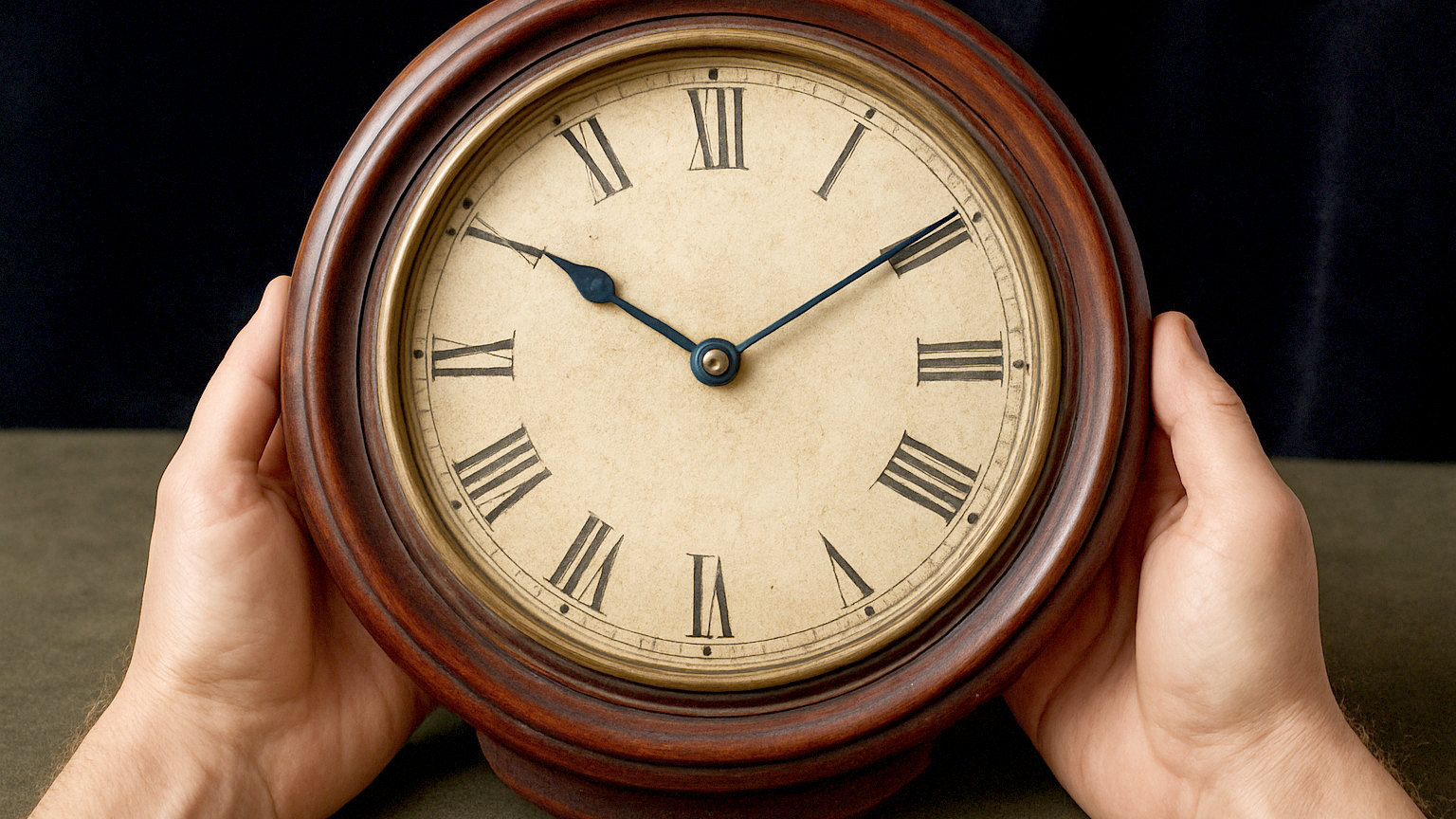
A wall clock consisting essentially of a large circular dial in a shallow wooden surround, with a spring driven movement behind and a hinged bezel carrying the glass.
They were made for schools, offices, waiting rooms, railway stations and workshops, where a clock needed to be legible from a distance and required minimal attention. The plain circular form is functional rather than decorative, which is why so many survive.
What is a drop dial?
A variant with a box extending below the dial, housing the pendulum and giving access to the movement. The box is frequently glazed so the pendulum can be seen, and it is often shaped or decorated.
Drop dials accommodate a longer pendulum, which improves timekeeping. Look at whether the trunk below is original to the dial surround by checking the timber, the colour and the way the two meet, since marriages between an orphaned dial and a later trunk do occur.
What does dial size tell you?
The intended setting. Very large dials were made to be read across a hall or a platform, so a substantial diameter indicates public or institutional use rather than domestic.
Measure the dial rather than the case, since the case adds a variable amount. Larger dials generally command higher prices where the clock is decorative, though very large examples can be too big for a modern room, which limits the buying audience in the usual way.
How do you assess the movement?
Open the bezel or the rear door and look at the plates. Better movements are well finished with neatly cut wheels, and may carry a maker name or a serial number.
Establish whether the clock is a timepiece with a single winding hole or a striking clock with two. Fusee movements, using a chain and cone to even out the mainspring force, indicate better quality English work and are common in dial clocks. Look for the cone shaped fusee alongside the barrel.
What should you check on the dial?
Whether it has been repainted, which reduces value substantially. Original painted dials show fine crazing in the paint surface, consistent wear around the winding hole from the key, and lettering with the confident consistency of a specialist hand.
Repainting shows as lettering slightly too crisp with spacing that does not quite sit right, and the crazing and winding wear are usually lost. Check the numerals are correct for the period and that the maker or retailer name sits comfortably rather than looking cramped or added.
What about the case and bezel?
Look at the timber, the mouldings and the finish. Cases were made in mahogany, oak and ebonised finishes, sometimes with inlay or decorative painting on drop dial trunks.
The bezel is brass and hinged, carrying convex glass on many examples. Check the glass is present and original, since convex glass is expensive to replace and modern flat glass in a bezel designed for convex looks wrong. Check the bezel closes properly and its hinge is sound.
How should one be hung?
Securely and level, into something solid. Wall clocks are heavier than they look, particularly large dials with fusee movements, and the fixing must take the weight plus the shock of winding.
Fix into masonry or into a stud rather than into plasterboard alone. Set the case level so the pendulum swings symmetrically, then listen to the beat, which should be even. Move the case very slightly to one side until the tick and tock are evenly spaced, since a clock out of beat will stop within hours.