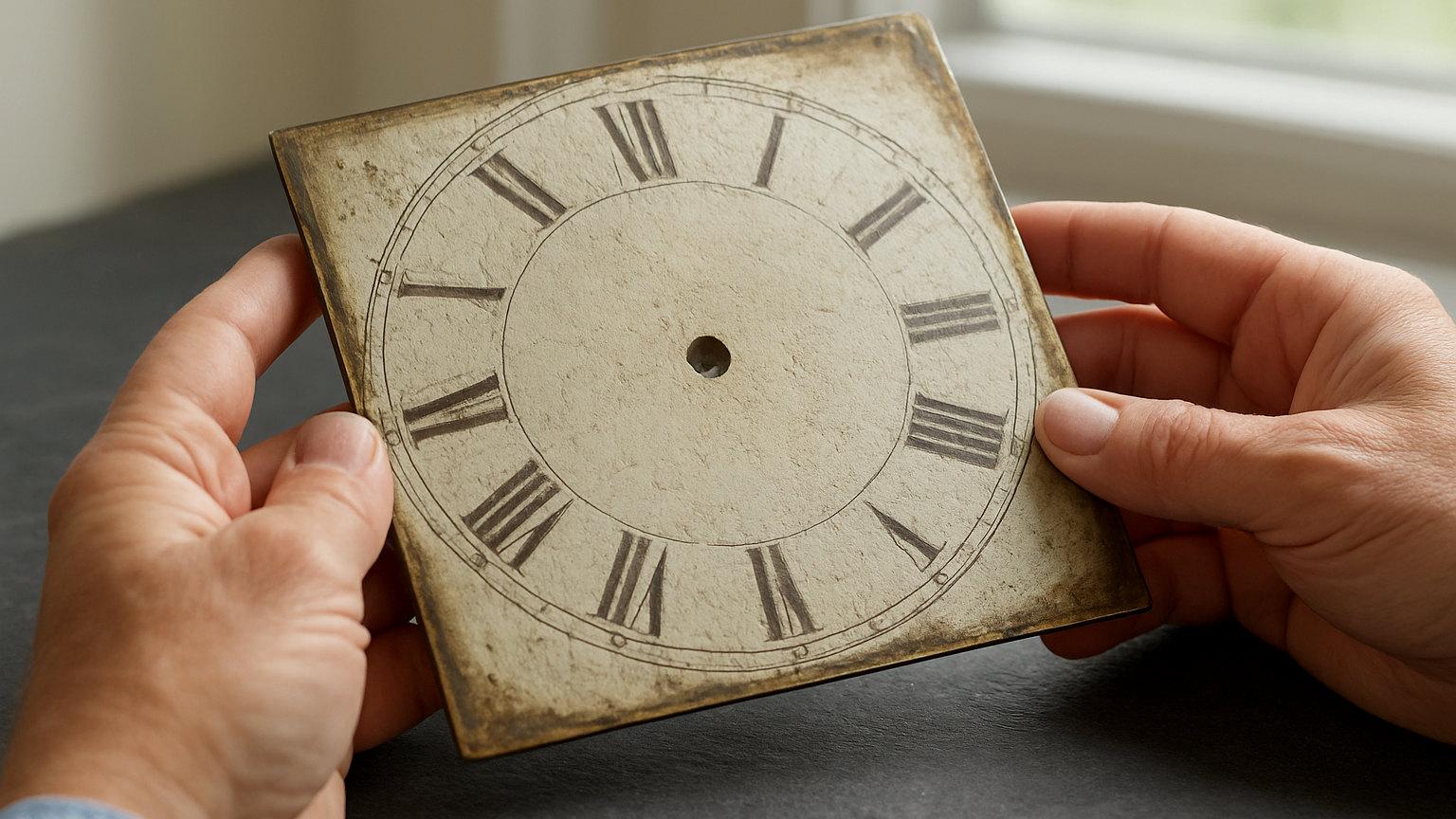
The dial is the face a clock presents to the world, and it changed more visibly over time than almost any other component. Materials, construction and decoration all moved through a recognisable sequence, which makes the dial one of the quickest ways to place a clock. It is also the part most frequently ruined by well meant restoration.
What is a composite brass dial?
An early arrangement built from several separate pieces rather than made as one. A brass plate forms the base, with a separate applied ring carrying the hour numerals, cast decorative corner pieces, and often an applied name plaque.
That ring is called the chapter ring, and on early dials it is silvered so the engraved numerals show black against a pale ground. Look at whether these components are genuinely separate pieces pinned to the plate from behind, since that construction indicates earlier work.
What are spandrels?
The decorative castings applied to the four corners of a square dial, filling the space around the circular chapter ring. They were cast in brass and screwed or pinned on.
Spandrel designs changed over time and are documented, so the pattern is a dating feature in its own right. Check that all four match each other and show consistent wear and gilding, since replacements are common. Compare the casting quality: early spandrels are crisply cast and hand finished, later ones softer.
When did painted dials appear?
Later, and they replaced brass largely because they were cheaper to produce and easier to read. A painted dial is an iron or sheet metal plate coated in white ground with numerals and decoration painted on.
Early painted dials are restrained, with simple numerals and modest corner decoration. Later ones become more elaborate, with painted scenes in the corners and in the arch. The style of that painted decoration is a reasonably good dating guide, moving from sparse to florid.
How do you spot a repainted dial?
By the quality and consistency of the lettering. Original painting was done by specialists who produced enormous numbers, so numerals are confident and evenly spaced with consistent weight.
Repainting frequently shows lettering that is slightly too crisp, spacing that does not quite sit right, and a surface lacking the fine crazing that old paint develops. Look at the winding holes, since original dials show wear around them from the key, and a repaint usually loses that. Repainting substantially reduces value even when it looks better.
What should you check on the hands?
That they match each other and suit the dial. Hands were made in matching pairs, so the hour and minute hand should share a style, a metal and a similar degree of wear.
Mismatched hands are extremely common and are a cheap fix that buyers notice. Check the hands are the right length, with the minute hand reaching the minute track and the hour hand reaching the numerals. Blued steel hands should show an even colour rather than patchy heat marks from later treatment.
Does the dial match the movement?
It should, and checking is important because marriages are common. The dial feet, which are pins projecting from the back of the dial, should fit the holes in the movement front plate cleanly.
Extra holes, plugged holes or feet that have been moved indicate the dial has been fitted to a different movement. Check the dial fills the case aperture cleanly too, since a gap around the edge or an enlarged opening suggests dial and case were not made for each other.
Should a dirty dial be cleaned?
Almost never by an owner. Painted dials in particular are extremely vulnerable, since the paint is water soluble in places and a damp cloth can take numerals off entirely.
Silvered brass chapter rings tarnish and the silvering can be renewed by a specialist, which is legitimate restoration. Leave everything else alone. Dust with a very soft dry brush at most, and take anything genuinely dirty to a clock restorer who works on dials rather than attempting it yourself.