Glass carries fewer marks than any other antique material, for a practical reason: the surface is hard, glossy and unforgiving, and until acid etching became available there was no way to mark it permanently without spoiling it. What marks exist are frequently so faint that people handle a signed piece for years without noticing.
Where should you look?
The base first, in the area around the pontil, and then the rim of the foot. On vases and bowls check the underside of the foot rim itself, which is where most signatures sit.
Some makers signed on the body near the base, and a few within the decoration itself. On cameo glass the signature is frequently carved into the design as though part of it. Turn the piece slowly under a single light rather than searching in flat illumination.
Why is raking light essential?
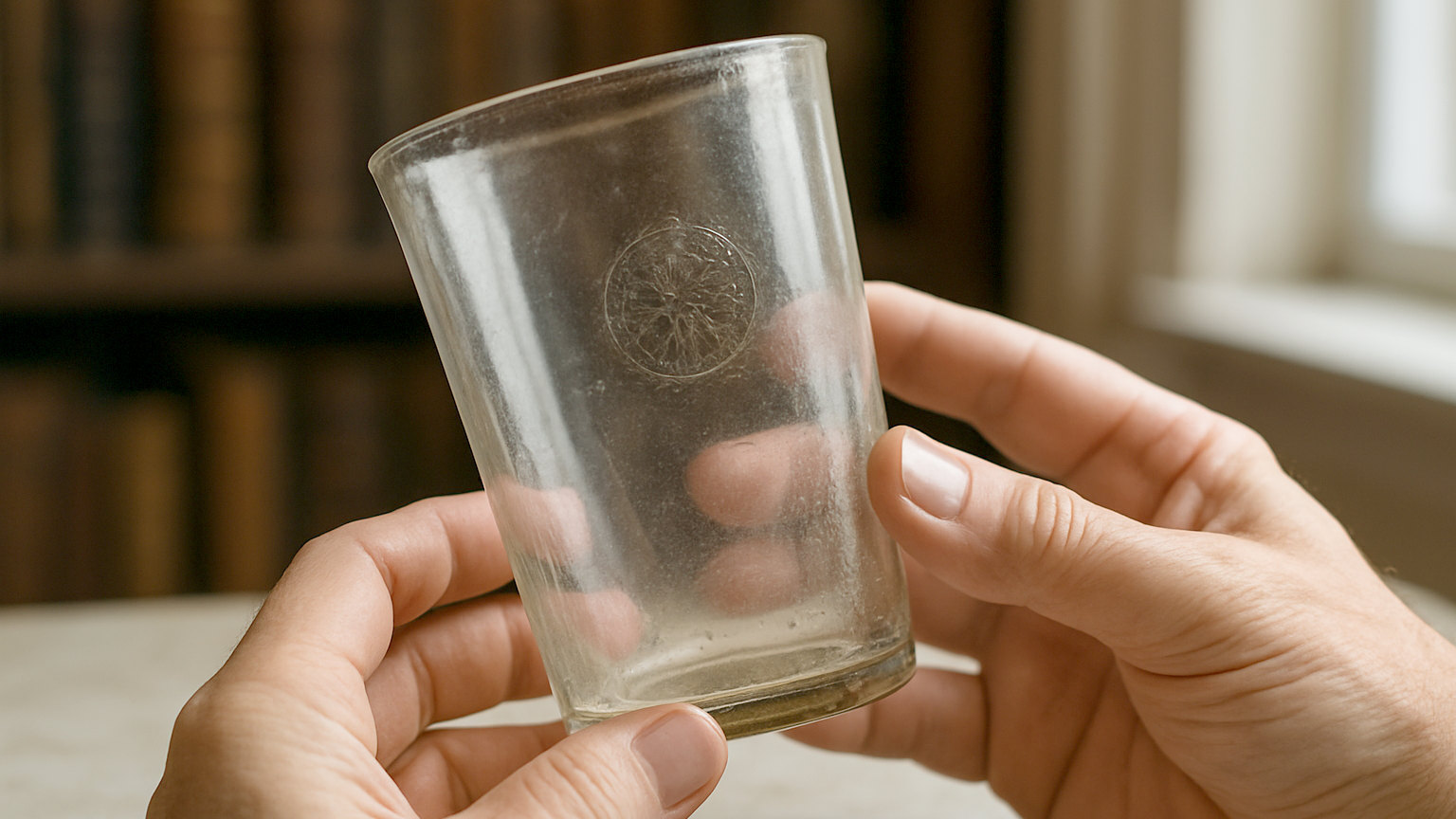
Because an acid stamped or engraved mark on clear glass has almost no contrast. It is a change in surface texture rather than a change in colour, so it only becomes visible when light catches it at the right angle.
Hold the piece so light skims across the base at a shallow angle and rotate it. A mark that was completely invisible will suddenly appear as a faint frosted shape, then disappear again as you continue turning. Photograph it at exactly that angle.
What kinds of mark are used?
Acid stamped marks appear as a slightly frosted design, applied by masking the surface and exposing it to acid. They are the commonest form of factory marking.
Engraved or wheel cut signatures are scratched into the surface with a rotating wheel or a diamond point, and these are usually the mark of an individual maker rather than a factory. Moulded marks are formed as part of the piece and appear in relief or intaglio. Paper labels were also used and rarely survive.
What about paper labels?
Worth checking for, since a surprising number survive on pieces kept in cabinets. Look on the base and on the underside of the foot for a label or for the ghost of one, visible as a slightly duller patch where adhesive remains.
Never clean off a residue patch, since it is evidence a label was present. Where a label survives, photograph it and do not attempt to lift or flatten it. Labels frequently carry a maker name, a pattern number and sometimes a country of origin.
Does an absent mark mean anything?
Almost nothing. The great majority of antique glass, including a good deal of extremely fine glass, carries no mark whatever. Marking became usual only once makers had a commercial reason to build a brand.
Identify unmarked glass by the metal, the technique and the form instead: the colour and clarity, whether there is a pontil mark, whether decoration is cut or pressed, the weight, and the ring when tapped gently. These narrow the field far more than mark hunting will.
How do you check a signature is genuine?
By asking whether it suits the piece. Celebrated names were added to unsigned glass once the market recognised them, and a crisp signature on a piece whose quality does not support it should be treated sceptically.
Compare the signature form against documented examples, since makers used particular scripts and positions consistently. Look at whether an engraved signature shows the slight irregularity of wheel work or the mechanical evenness of a modern tool. Where sums are significant, get a specialist opinion.
What should you record?
The mark exactly as it appears, its position on the piece, and how it was applied, since all three matter for identification. Photograph under raking light from several angles.
Record the dimensions and weight as well, and describe the colour, the technique and any decoration. A well described unmarked piece gets identified by specialists far more often than a poorly photographed signature, because the object itself carries most of the evidence.
What should you never do?
Attempt to make a faint mark clearer by scrubbing, polishing or applying anything. An acid stamp is a shallow surface texture, and abrasion removes it permanently.
Wash the base gently in warm water to remove dirt, dry it, and then use light rather than force. If a mark is genuinely illegible, describe what you can see of its shape rather than guessing at the letters.